Tag Archives: god

The Meaning Of Breakfast

It’s the month of Ramadan – the month in which the Quran was revealed and the month in which we have been bound to fast for the entirety of it.

Don’t worry, we don’t fast non-stop the whole month – just from dawn to sunset.

Have you ever tried going a day without food?

Years before I chose Islam, I tried a juice fast one day (where all you consume is fresh juice – no solid food).

I couldn’t make it through half the day! I never tried it again.

But things that are difficult outside Islam, become easier within it. Like giving up bad habits, or in this case, fasting.

In reality, everyone fasts… but throughout the night, while they sleep.

That’s why breakfast is break-fast!

That’s almost exactly what fasting is in Islam, except in Islam it is done during the waking hours – the consciousness is an important part of the experience. As is developing willpower over one’s desires, gratefulness toward the Provider of our sustenance as well as appreciation and mercy towards those who struggle to survive against famine and poverty.

So, while you may fast every night and break your fast in the morning, you are missing out on the many benefits you could be reaping had you fasted instead throughout the day!

When fasting, one abstains from what is not only lawful (halal) but also necessary for survival – food and drink.

The benefits are many, but I will list a few here for you to consider, to give you a glimpse and hopefully an appreciation you may not have had before.

First, fasting in Islam is an act of worship – and it’s nothing new or strange. It has long been a part of the way of life laid out by our Maker practiced and taught by previous prophets such as Moses and Zacharia:

“O you who have believed, decreed upon you is fasting as it was decreed upon those before you that you may become of the righteous (those who have taqwa) -“ (Quran 2:183)

Let me explain to you what worship means, because the definition of worship in Islam is broader than you might think. Worship isn’t just rituals; it encompasses every aspect of life. Worship in Islam is doing anything that is pleasing to God (which we can only know via His revelation to us; His relating and describing to us what is acceptable and pleasing to Him) and abstaining from that which He has forbidden – that which is not pleasing to him of our actions.

So in Islam, smiling at a person is an act of worship. Not lying is an act of worship. In this case – the case of Ramadan, fasting is an act of worship.

As with all acts of worship in Islam, the benefits are plentiful and manifold.

The main reason for fasting, as God explained for humanity in the Quran, is to attain taqwa – which is an arabic word with a rich meaning that entails God consciousness (remembering God and aligning one’s actions with the purpose of life on earth- remembering God in every action). This acts as a shield for the person who has it, that protects them from the harmful pitfalls and diversions of life.

So we do it to gain greater consciousness of God, which helps us live better, more successful lives.

Ramadan is like a leg-up. Throughout the year, we might be progressing slowly, or even backtracking, but Ramadan helps the individual who takes advantage of it, make a leap of progress in a relatively short time.

By no means is it merely abstaining from food and drink, by which one can attain this spiritual benefit and increased closeness to our Creator – The prophet Muhammad reminded us that God is not in need of our fasting and that it is virtually pointless if we do not also abstain from false talk and other bad behavior. (Bukhari,Muslim)

He also said: “Many people who fast get nothing from their fast except hunger and thirst, and many people who pray at night get nothing from it except fatigue” (Darimi).

And so we are warned not to be of those who only get hunger and thirst out of fasting, but to strive for broad self discipline and that greater God-consciousness.

There is the spiritual side, the self-discipline side of it, and believe it or not, there is also a physiologically beneficial side to fasting as well!

Scientific studies in animals and humans show that fasting is largely beneficial to physical health. It promotes stem-cell regeneration, boosts immunity and helps slow the proliferation of cancer. There are many articles you can research on this but here are two for you to take a look at if you are interested:

http://www.medicaldaily.com/fasting-may-improve-immune-system-health-during-aging-process-chemotherapy-patients-may-also-benefit

http://articles.mercola.com/sites/articles/archive/2014/06/14/intermittent-fasting-longevity.aspx

So next time you eat breakfast in the morning, think about those of us who break our fasts at sundown.

What do you think it would be like for you if you were not to eat or drink all day?

A Day In The Life

It’s late Sunday night. My whole family is asleep, even my husband. He’d been up since the dawn prayer.

Not me; I was so tired this morning, I fell right back asleep after we prayed

together

before the sun peeked over the horizon.

Then I woke up to my children climbing over my back. I heard the tick, ticking of my husband’s fingers typing away at the desk near the windows.

The morning light poured into our home.

My youngest, just two, was near my head whining:

mooooommmmaaaaaa, mommmmaaaaa, I want milkeeeeeeeee…

My husband rubbed my sore back so I could get up and start the day.

It’s Sunday, so no rush…

So I ran to the grocery store, our littlest in tow. She loves to drive the car affixed to the shopping cart, as I whiz through the aisles.

I love going shopping without all five of my children with me.

As I cooked breakfast, I listened to the Quran.

We had bagels and scrambled eggs. I got an extra large coffee to make up for not having any yesterday.

I had several meetings with my business partner, who is also my husband. We have a lot of work to do.

My oldest daughter was so excited that her friend was coming over today, until we got the unpleasant news of cancellation. The rest of her day was spent fighting back tears of disappointment. She’s eight years old.

I have a bunch of plants I haven’t been able to finish planting in our garden. I attempted it today but decided to take a few nature photos first and before I had a chance, I was graced with a visit from my neighbor, who I haven’t chatted with in some time.

Meanwhile my two oldest children were working out how to assemble some drawers for a closet system we are installing in the master bedroom. They did a pretty great job considering I was busy talking most of the time while they put them together.

When I went inside, I noticed a bucket filled with water near the kitchen sink with some Lily of the valley flowers in it. A torn note nearby said: for Mommy, from Ibrahim. That’s my son’s work, he’s so thoughtful like that.

I tried repeatedly to comfort my daughter who’s friend couldn’t come; while I made peanut butter and jelly sandwiches, the food of choice for my son, fourth in line, who is almost four.

They devoured their sandwiches and ran outside to play. All but my oldest. Emotional.

While my husband and I held yet another discussion, my 5 year old daughter got a nasty cut on her toe. Several rounds of bandaids, peroxide, and hugs followed.

We break for prayer.

It turned out that my poor baby with the cut toe fell asleep before my lasagne was ready and kept on sleeping right up until bedtime, until now.

I remembered when I had fallen asleep so early as a child and how it didn’t affect anything. No matter, no responsibilities…..

So we sat down to dinner together minus one. As our five year old slept, our two year old entertained the rest of us. She talked at the top of her lungs in her deep-for-a-two-year-old voice, about birds and balls and all sorts of baby talk that had the other three children in uproarious laughter. My oldest momentarily forgot her boredom as she enjoyed her sister’s antics.

Normally neither my husband nor I would tolerate such ill manners at the table, but tonight it was sweet and we just smiled and watched them. Their beautiful, innocent faces giggling and bright.

There was an amazing accomplishment at dinner. Zak, the PB&J eater, was coaxed by his older brother into eating a copious amount of green beans. Believe me, that is worth writing down.

After everything was all cleaned up (well, almost) and the kids were all changed and teeth were brushed, I sat down at my desk and did some more work (the kind I love to do) and now here I am, recapping an average day for you.

Being Muslim doesn’t make my life strange, or my days much different, but it does add a few things:

Five times today my husband and I (and some kids here and there) stopped everything and stood to pray, trying our best to clear our minds of all of life’s clutter and to focus on the source of life; One greater than all the world and it’s trappings.

Reorienting ourselves, remembering what it’s all about, and how temporary it all really is.

We took the time to be close to our Creator, in gratitude and in need. In need of His guidance, His help. Humbling ourselves before Him with our foreheads on the floor.

In between the prayers I got angry at my daughter, who was crying and crying and complaining of boredom, but I remembered how the prophet Muhammad said, “Don’t get angry.” and he taught us how to minimize it.

I’m not always good at that, so when I lost my patience and yelled at my kids for not cleaning up, though I had asked several times – I thought about how they have been entrusted to me by the Owner of everything;

They are not mine, but His – and my responsibility is to treat them with care –

so I asked for His forgiveness.

When my son was talking about another boy in his class, who he thinks has really great behavior (something my son struggles with) I encouraged him to say a prayer for him, that his friend would be increased in goodness and granted success. I reminded him, that the prophet Muhammad said that when we say a prayer for someone else, an angel makes that very prayer for us. Encouraging him to wish good for others, so that it could also increase the good he receives.

When I kiss my kids good night, I remind them to sleep with remembrance of their Maker.

I wish them peace as I turn off the lights.

I’m tired now. My husband has just reminded me about how tired I was this morning. I should go to bed.

As I do, I will remember God and I will remember death. I’ll ask Him to help me be better tomorrow, to get up on time to stand in prayer,

before the sun peeks over the horizon.

20140519-003029.jpg

American Girl to American Muslim: Before and After

I was always a carefree American girl.

I have always lived a comfortable life, had a loving family…

My parents gave me a nice combination of support and independence. I always knew they’d be there for me, yet they let me explore, push my boundaries and even make mistakes.

I have three amazing, good natured sisters; lived in comfortable homes on perfect streets. I was given every opportunity.

I was always fortunate.

Choosing Islam has only improved the quality of my life.

So my before was great and my after is even better!

I’m now happier, more satisfied and grounded than I was and more than I believe I could have ever been without Islam.

I chose Islam and it enriched my life. It gave me answers and solutions. Remedies, skills and preparedness. It has given me clarity, purpose, discipline and goodness.

I’ve learned how to be a better human being, to have patience, to be a good wife and mother; to be a better daughter and neighbor.

Islam has even confirmed and solidified much of what I was raised upon. In fact, there were lessons and values I was taught as a child such as:

“If you don’t have anything nice to say, don’t say anything at all”

– Mom (and Bambi)

which I didn’t exactly follow…

but I earnestly try to now; because of Islam.

The prophet Muhammad said,

“Whoever believes in God and the Last Day should speak a good word or remain silent.”   (Bukhari, Muslim)

So that is what I strive to do.

Being kind to others and not being selfish are values most people appreciate, teach and try to embody; but when I look back on instances of my past, I realize that before Islam, I was sorely lacking.

One example of this which I can’t get out of my mind, occured during my early college years.  I was impatient with my grandmother who had come to see my school one day.

I was very athletic and fast and always in a rush. She however, needed time to climb the stairs and it was hard for her, but I didn’t stop to lovingly help her – I rushed on, rolling my eyes, annoyed at her pace.

That will forever be a regret I will carry.

I know that if the same scenario were to happen today, nothing would be more important to me than showing kindness and compassion for my elderly grandmother. That is because of the deep understanding I now have, knowing the weight of our deeds and that God is pleased with kindness and mercy.

The Quran and the prophet Muhammad emphasize kindness to parents and the elderly:

“Your Lord has commanded that you worship none but Him, and that you be kind to your parents. If one or both of them reach old age with you, do not say to them a word of disrespect, or scold them, but say a generous word to them. And act humbly to them in mercy, and say, ‘My Lord, have mercy on them, since they cared for me when I was small.” (Quran 17: 23-24)

This applies to grandparents as well.

The Prophet said,

“He is not of us who does not have mercy on young children, nor honor the elderly.” (Al-Tirmidhi)

This story of my grandmother is just one example of how Islam can change a person for the better, as it did with me. The areas in life where you can improve, it gives you the tools to improve them.

More importantly, it gives you the will and desire to change.

It gives deep seated motivation to be the best you can be, not only in how you deal with people, animals and the environment – but preceding that and superseding that in importance, is the motivation to give God His right over us and to truly live to serve and please Him and Him alone.

To do that, we need to know what His rights are; what is pleasing and displeasing to Him. In Islam, we believe He gave humanity that guidance, a recipe for our success.

We fear His displeasure and hope for His reward and acceptance. Our love for Him should guide our every action.

This gives us an eternal source of inspiration.

Another beautiful thing about this, is that there is always someone who will appreciate the good you do, even the good you intend to do. So you never have to boast about it, or be dissapointed if no one recognizes your efforts.

In Islam, we are taught that God is closer to us than our own jugular vein; that He knows our thoughts and that which is in our hearts. He is appreciative of every effort and every good intention. He does not let any good go to waste.

When we fail and turn to Him, He always hears us, knows our sorrow, our regret.

We are taught in the Quran that God is the most Merciful, The Most Forgiving, The Most Loving, The All-Knowing, All-Mighty and Extremely Fair, the Most Just.

So there is no despair, no grief, for the one who understands God and has certainty about who He is.

What this also means, is that success and satisfaction are not limited to people who have had easy lives, who grew up in luxury and love.

Anyone from anywhere and with any history can achieve and excel.

I presented my story so that you can know I am not climbing out of difficulty to Islam, I lived in ease and comfort my whole life. Yet, Islam improved my life and made it that much better and more rich. But whatever a person’s background, Islam promises peace, support and a kind of contentedness you can’t find anywhere else.

I’m not perfect and I never will be, but now that I have Islam, I know the path to take, to be the best me I can be.  🙂

I Was Born Muslim

Did you know everyone was born in a state of Islam?

It’s true.

I didn’t choose my gender… did you?

I didn’t choose my eye color or hair. I didn’t choose my country; my family, my language.

I was born in submission. I was born a Muslim.

We all were.

But humans only remain in the state of natural Islam for a short time until our free will kicks in; Then it’s up to us what we do and what we believe.

You were taught to be a Christian, or a Jew, or an Atheist, or a Hindu, or a Buddhist or whatever you might have been as a child. 

I used to go to Catholic church, because my family is Catholic.

But we all have had a spiritual spark embedded in us. Kind of like a homing feature.

It’s our intrinsic spiritual and moral disposition. In Arabic, it’s called the fitrah.

It is the reason why some  people search for truth. They know there is something more to this life.

Do you remember wondering?

You probably had all kinds of big questions, like:   Why are we here?   What’s the purpose of life?   How do we know if we are doing what we are supposed to be doing?   What happens when we die?   Why is there suffering?   What is reality?

Does God exist?

In some though, especially after time passes and questions go unanswered, that spark can be completely buried and forgotten.

There are other tools and evidence that support the fitrah though; if we are willing to look.

My unique fingerprint is a sign.

Snowflakes, fruits, the sun and the moon are all signs.

When I look in the mirror at the features I didn’t choose, I remember where I came from.

As I age and begin to notice, that the lines on my face don’t disappear after I smile anymore;

I remember where I am going. 

Freely choosing to submit to the guidance provided by our Maker is like following the instruction manual for a machine. It doesn’t make any sense to use a refrigerator as a bookshelf or a computer as a chair.

I would’t use my lawnmower on my hardwood floor or my vacuum in my garden.

Following the guidance is like that. Using your existence for it’s purpose.

The sense of relief that comes with that is indescribable.

When you align your will with the supreme will of the one who designed us, you accept that you have curly hair, or brown eyes. You realize you couldn’t have been born to be a little taller or more attractive. You are supposed to be just how you are.

You then focus on the things you can control: choosing between good and bad actions, using your time wisely.

You can stop fighting what can’t be fought.

And the link between the two involuntary submissions: birth and death, is complete.

It’s the only way to make the transition from one, to the other

in peace.

They’re speaking Muslim!

One reason Islam might seem unfamiliar is due to the preference and tendency of Muslims to use Arabic words and phrases- even amidst an otherwise English conversation.

If you were standing in line near me at the grocery store let’s say, and my cell phone rang, you’d probably hear me answer it and say, “assalamu alaykum! How are you?”

When my friend asks me how I’m doing, I’ll probably answer, “alhumdu lillah! I’m fine!”

Then I might let them know I’m busy and say, “I’ll call you back, insha Allah.”

So why does someone like me, who only speaks English need to mix Arabic and English when I speak?

Good Question.

Well, I don’t have to and I’m not trying to alienate you. There are reasons I choose to, though.

If I am speaking to a person who is not Muslim I will most often either translate those very same phrases or I leave them out altogether. (I still say them in my mind though!)

Some things just sound weird in English to me. I love the meanings of them, but that’s because I understand those meanings through the perspective given in the teachings of Islam.

Imagine if every time I met you, I was like, “peace be upon you.” or “May peace be upon you, and the mercy and blessings of God.”

It’s not a part of our social culture, therefore it is strange to our ears.

The only familiarity American Christians might have with this greeting is from church, when the priest says to the congregation, at a ritual aspect of his sermon,  “Peace be with you” and the people respond in unison, “and also with you”.

The meaning is lovely if you think about it, but when when I had to say it in church, it felt unnatural for me. Many other sayings and actions especially of the priests and clergy just didn’t resonate with me and felt strange at the time. It made me feel uncomfortable. I think it was really because those concepts were so divorced from the speech and meanings of everyday life.

We weren’t taught much about the practicality of religion and the origins of such phrases; causing them to feel alien and artificial – it was never common practice to greet one another in that way.

In Islam, everything we do has a clear reason and/or proof behind it. So we know exactly why we say “peace be upon you” when we meet one another, we also can learn the in-depth precise meaning of the word “peace” which is “salam” in arabic.

The meanings of “salam” and “peace” can actually have slight differences. Arabic words tend to be rich with meaning, so when I say “salam” that is more clear and accurate as opposed to saying peace. Make sense?

So, for example, this particular greeting, “peace be upon you” is actually as old as humanity. There’s a good reason priests say it in their sermons, and you’ll find orthodox Jews and the Jews who live in Israel all greet one another saying “shalom” which means salam, which means of course, peace.

It was the greeting taught to Adam as soon as he was given life and it has remained a part of God’s guidance ever since then. For most (Non-Muslim) English speakers it has been lost and we are no longer familiar with it, outside of church.

The meaning is extraordinarily beautiful and it needs to really be said and practiced with sincerity in order to be fully appreciated. When you meet someone or address someone with “peace be upon you”, you are beginning by saying a prayer for them and their general wellbeing. You are also indicating and reminding yourself that your dealings with that person are peaceful and that you wish good for them, not harm.

How you proceed after that should be in line with that intention, if you are conscious of what you have said and you meant it.

It’s lovely; anyone who believes in God might appreciate a prayer like that being made for them as a greeting, but functionally, in English at least, it is awkward. That’s why I say it in Arabic to my Muslim friends and that’s why I don’t even say it when I’m not speaking to a Muslim person.

So let’s take another example, the word God. In a previous post I explained the meaning of the word “Allah” and that it is interchangeable- to a degree- with the word “God”.

But god is different in that it can be changed to be plural: gods.

It can refer to something entirely other than the Creator of all that exists: “He made wealth his god.”

There is no scripture stating that God’s name is… God.

So it doesn’t feel right to me. The meaning is there; enough to use the word God to serve a purpose of communication, but if I am speaking to another Muslim, of course I will choose to use the name Allah.

Linguistically, you can’t say “He made wealth his Allah.” You would say instead, “He made wealth his ilah.”

Ilah (ee-lah) is something worshipped, very similar in meaning to the word god.

God (Allah) chose Arabic for His final revelation to mankind. Once you get a little familiar with Arabic, it becomes clear why. It’s extraordinarily expressive and rich with meaning, and in spite of what one might think, it’s actually very easy to learn.

In Islam, there is a big focus on remembering God. We have things to say and do all throughout every day to keep our Maker and our purpose in our minds at all times. 

We have been instructed in the Quran, for example, never to say we will do something in the future, except if we add to it, “insha Allah“. (Quran 18:24)

Insha Allah means: if God wills, or God willing. That’s a phrase many people still use today, especially practicing Jews. So unless I am speaking to a Muslim person, I will say “God willing.”

But if you and I are talking and I say, “I am traveling tomorrow, God willing.” Is it immediately clear to you what I mean by that?

Finally, I will explain one final saying that I mentioned in the beginning of this post because it is very common: alhumdulillah (al-hum-do-leel-lah)

Now if I were to translate this into english it’s not even really possible with a couple of words. When we say alhumdu lillah, we are praising God, ascribing perfection to Him, and indicating that He is most worthy and deserving of praise and gratitude. Not only that, but also that He is The Owner of praise and perfection.

So imagine if you ask me how I am doing, and I say, “I am well, All thanks and praise are due to God and He is most deserving of it. The perfect, The Owner of praise.”

I think in our culture, in our English language, it seems a bit much. I don’t expect anyone who’s not a Muslim to get it.

So that’s why we use Arabic.  I hope I haven’t bored you with lots of technical talk, but I do want to open doors of understanding.

If you keep this in mind, at least you may not feel so uncomfortable if you happen to be on line in the grocery store, next to a Muslim who gets a phone call.

Why me?

I had always felt that the path that led me to Islam was somehow paved by me.

I thought it was my actions, my choices that prepared me and that it was I who discovered it.

I vetted it out. I did countless hours of research. I couldn’t deny it’s truth.

I.

me.

I would marvel at all the events and decisions that lined up so incredibly perfectly.

And I thought it was amazing how I did that.

Not long ago however, I began realizing fully, how truly blessed and indebted I really am.

I’ve always been grateful, but I had gained a deeper consciousness of what Islam really means to me and how empty life would have been without it – And I started to really wonder-

Why me?

Why did God bless me with His guidance? I wasn’t any great person before, just regular: not especially kind or righteous in any way, not inclined to religion at all

And then one day it hit me. I know why now.

I remember the moment.

I was the kind of person who loved going to the beach at night. I remember running along the shore, as fast as I could under the stars.

The stars.

I remember the exhilaration of looking out into the unfathomable night sky, enamored.

I remember laying in my bed on saturday mornings as a teenager and wishing I could know everything about the world. What happened before me, what would happen after me. I would imagine that I would be given a view of the Earth and I’d be able to just watch history unfold.

I asked a lot of questions. I found it exciting.

Especially when the answers seemed unknowable.

So, after all that wondering and all the marveling I did at leaves and insects and stones; after looking at the astonishingly beautiful stars so many times and trying to comprehend how little me, a speck of intricately formed insignificance, could be living on a spinning rock flying around a burning orb suspended in a gorgeous galaxy – merely a blip amongst the others.

How? Why?

I think subconsciously I knew the world; humanity, beauty, pain- They couldn’t have just popped out of nothing.

So one night…

I was a freshman – I was sitting in my dorm room window: a big, square window.

I was looking out at the sky.

And I said something.

I said to myself, there must be some force out there. There must be.

Then I spoke to that force, but not with my lips. Only in my heart, quietly. I asked to know.

I wanted knowledge. I wanted the truth.

Then I forgot about it. I went about my life after that, for four years.

But that force I had beseeched, had heard me. And gently, I was guided to get ready. To get ready for Islam.

I did the weirdest things.

I used to listen to music a lot. Somehow I completely stopped listening to music with words and switched to classical.

I won’t tell you what kinds of music I liked before, but let’s just say that was an unpredictable move. I did it as if it was perfectly normal. Natural.

Then after a while, I ditched classical and switched to ambient: you know, the music that’s not really music? It’s just some sounds, almost like an environment more than music.

At 18, I gave up TV. I forbid my roommates from having a TV in our common areas.
That was odd. I lost some roommates like that.

But what I had effectively done, or had been guided to do, was remove external influences. No one was chattering into my ear anymore, telling me what to think.

My mind was mine again! Or, you know what? That might’ve been the first time it was really my own.

I started pondering about holidays and birthdays and about saying “God bless you” when someone sneezed.

I stopped saying “bless you” when people sneezed.

I stopped, because I didn’t know what that meant.

It didn’t make any sense to me, so I’d say instead, “you okay?” or something equally awkward.

I stopped celebrating holidays. Nobody Liked that very much…

But I just didn’t understand who Jesus was and why I needed to celebrate his birthday with a tree and Santa. I didn’t get why I had to eat chocolate bunnies or what was so significant about turning one more day older.

I stopped doing things I didn’t understand.

Oh, except for the time I just had to travel to a war zone as an international observer so I could walk in front of tanks and M16’s. That was all gut.

That was also how I met the first Muslims I had ever seen, and how I heard the recitation of the Quran, for the first time.

The Quran that I had been reading a translation of for the previous year, because I was going to prove to the world that religions were all flawed and thus man made.

So the point is, I asked for this. I asked for guidance. I wanted answers and God, in His infinite Mercy, granted my wish, answered my request; answered all my questions.

Because in that moment, in that window, I believed in Him.

Even though I didn’t know anything about God at the time and I never would have used that word. Still, I was a believer in that moment. I realized my smallness, and His Greatness.

That was how it all began.

Islam: A Way Of Life

The word Islam is not just the name of a religion: It is a state of being and a way of life.

If you think about most other religions you know of, you will find that the name “Islam” is quite unique.

For example: Christianity is named after Christ. Judaism is named after the tribe of Judah. Hinduism is a word related to location.

Islam describes the state of being it entails. It can be translated as “surrender” or “submission” but really the arabic word Islam is too rich to translate into a single word.

Islam comes from a root word that denotes both peace and submission or surrender. In our context it means submission and surrender to God and His Will. It implies that one does so peacefully, in a peaceful state, as well as indicating that peace is attained through this submission.

A Muslim is one who does Islam. It’s the active form of the word. It could be translated as “one who submits to God” or “Submitter”.

So really when we say Muslim that’s what it means, we are just speaking arabic. Really in english I’m a submitter, but the word Muslim is common enough that I will continue to use it for my purposes here.

What we believe in Islam, is that God created the first humans, Adam and Eve. They were placed in paradise; The Garden of Eden. They were given a test: Everything in paradise was for them except one small thing. A single tree was forbidden to them.

Well, of course they made the mistake and disobeyed God, but that was merely the precursor for life on Earth. That mistake set the ball rolling, so to speak.

Adam and Eve were sent down to Earth where they were to live, reproduce, and die. But God did not leave them alone.

In their remorse over their disobedience, God Himself taught them how to ask forgiveness. He also promised not to leave them without guidance and told them:

“when guidance comes from Me, then whoever follows My guidance, they will have nothing to fear, nor will they grieve.” (Quran 2:38)

All that was setting the stage for a greater test: life on Earth.

Adam received revelation from God, and he submitted to that guidance and followed it. He was a submitter. He was a Muslim.

After Adam, God bestowed the prophethood on many, many more throughout the ages. Some of the names of God’s prophets and Messengers are mentioned in the Quran. Some of them are : Noah, Abraham, Isaac, Ishmael, Jacob, Lot, Aaron, Moses, Solomon, David, Jonah, Jesus the Messiah.

Sound Familiar?

We are taught all of them were given guidance from God. Some were given revelation, such as the Torah which was given to Moses and the Gospel given to Jesus.

All of them taught people to follow God’s Guidance-to submit to it.

That’s Islam.

Every one of them was a Muslim and no one can say they weren’t – because a Muslim is simply one who submits themselves to God. One who follows God’s guidance for success in life.

So we are just continuing along the path set for us from the beginning. God promised to send us guidance. He gave us the solace of knowing that if we are to follow His guidance, we won’t have any fear, we won’t live in grief.

And that is truly the gift of Islam.

What is Islam?

What is Islam?

Seems like a no-brainer right?

Even the dictionary explains it like this:

Is·lam
isˈläm,iz-/
noun
1. the religion of the Muslims, a monotheistic faith regarded as revealed through Muhammad as the Prophet of Allah.

That’s not the real meaning of the word though- And understanding the meaning of the word Islam is a simple explanation of the “faith” or religion described above.

The Arabic word Islam is derived from a root word: selema (seh-leh-muh) which carries the meanings of peace, purity and submission.

Islam means Submission to God and His will. It carries with it the implication that doing so is purity and that by doing so one will attain peace.

The trees, animals and planets are all in a state of Islam, because they are governed by God’s laws of physics, biology etc.; They function according to how they’ve been created. They naturally submit to God’s will. That is how they are programmed.

Humans are different.

We have been given a kind of intelligence unlike the rest of creation. We have been given free will and choice.

I can submit myself to whatever I want and so can you. We can submit ourselves to the love of wealth and material possessions or status. We can submit ourselves to pleasure and live hedonistic existences if we so desire. Each individual is free to choose their path.

Any person who chooses to submit his or her will to God peacefully, that person is in a state of Islam.

“Surely, the way of life with God is submission to Him.” (Quran 3:19)

And that, my dear neighbors, is what Islam is really all about.

20140103-115247.jpg

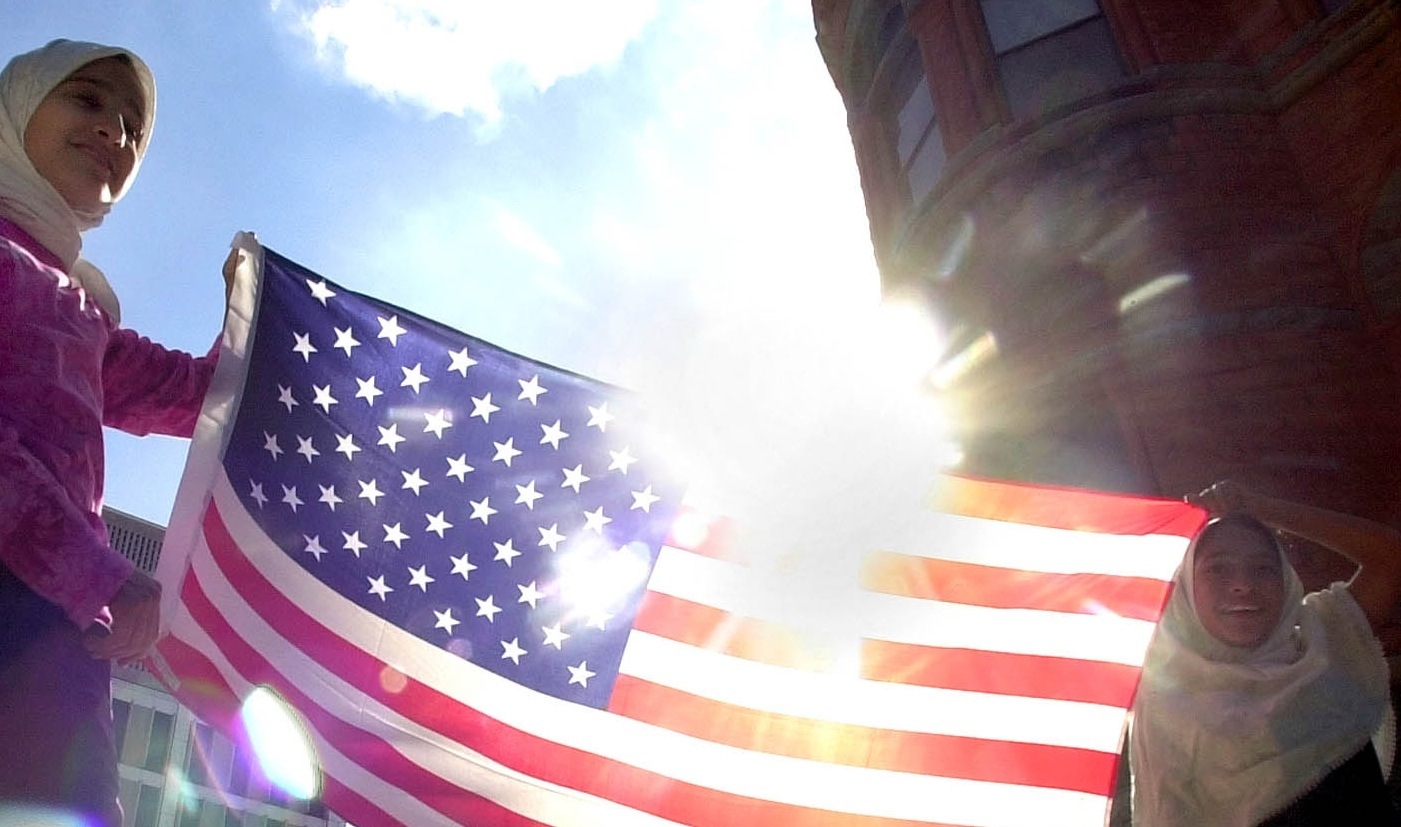
American and Muslim

I am an American of European descent. My grandparents were born here. My parents never knew any other home or any language beside English.

I grew up doing all sorts of typical American things; from parties and sleepovers to swimming lessons and horseback riding. We had amazing summers boating across the Long Island sound. We dug for clams with our feet in the shallow waters of the bay and stayed on the beach until sunset. We enjoyed backyard barbecues and fireworks. Our winters were brightened by snowmen, iceskating and mugs of hot chocolate.

When I chose to be a Muslim did I become less of an American?

Of course not!

I’m still me… and America is founded on the concept of freedom of religion.

In some ways, I am an ideal representation of what it means to be American by exercising my freedom of choice.

As it turns out, I’m more appreciative of my country, culture and many of the values I’ve been raised with now that I am Muslim, than I ever was before.

But does Islam conflict with American values?

The truth is, there is much more in common than there are differences. The concept that Islam is un-American is a fallacy and a relatively new one at that.

Did you know the Supreme Court of the United States of America honored the prophet Muhammad as one of the greatest lawgivers of all time as recently as 1935?

Maybe there is another reason that some people’s initial reaction is that those two terms can’t coexist?

Objectivity and a genuine interest in educating oneself about the facts are all that is needed to find out.

20131230-114600.jpg

Who is Allah?

When you hear the word Allah, what do you think? What comes to mind?

When you hear the word God, what comes to mind?

Before I was Muslim, I didn’t like religion. When I heard the word “God” I used to cringe. After a lot of reflection though, in my late teens, I decided there must be some kind of “force” out there- but I wouldn’t call it “God” (even in my private thoughts)… Just because I didn’t know what it was- or how I could know.

Now, even though I commonly use the word God in order to explain aspects of Islam, I prefer to say Allah.

Here’s why: Allah is the name of God.

If you look into history, you will discover that not one prophet or original religious scripture that we know of, referred to God as God.

Abraham, Moses and Jesus did not use the word God. Look up the etymology of the word yourself and you will see it’s origin is not from God as far as we know.

An additional issue with the word God is that it can be made plural. There can be one God or many gods. So often when I refer to God this way I will qualify it with a description such as “the One and Only God, Who created everything”.

Some assume when we say Allah, that we are referring not to their God, but some other concocted god. But I assure you that when we say Allah, we are referring to The One who created you and me. It is the same word Christian Arabs use for God, and similar to what we know that Jesus used to call God.

Other reasons I prefer to say Allah are because that is the name He has called Himself and the word itself embodies the meaning of who God really is.

The word Allah is formed as a combination of “al” (the) and “ilah” (one who is worshipped). So in English if you were to say “THE God” or “the One true God” or “the only One worthy of worship”, all of these describe the meaning of the word “Allah”.

So next time you hear someone say Allah, remember it means the One True God, the only One worthy of worship. Not the moon, or a building in the desert or a “god of another religion” but our Creator. The One who sustains us and provides all our blessings.

20131229-144013.jpg